What happens when a qualified patient is ready to engage... and nobody's available to respond?
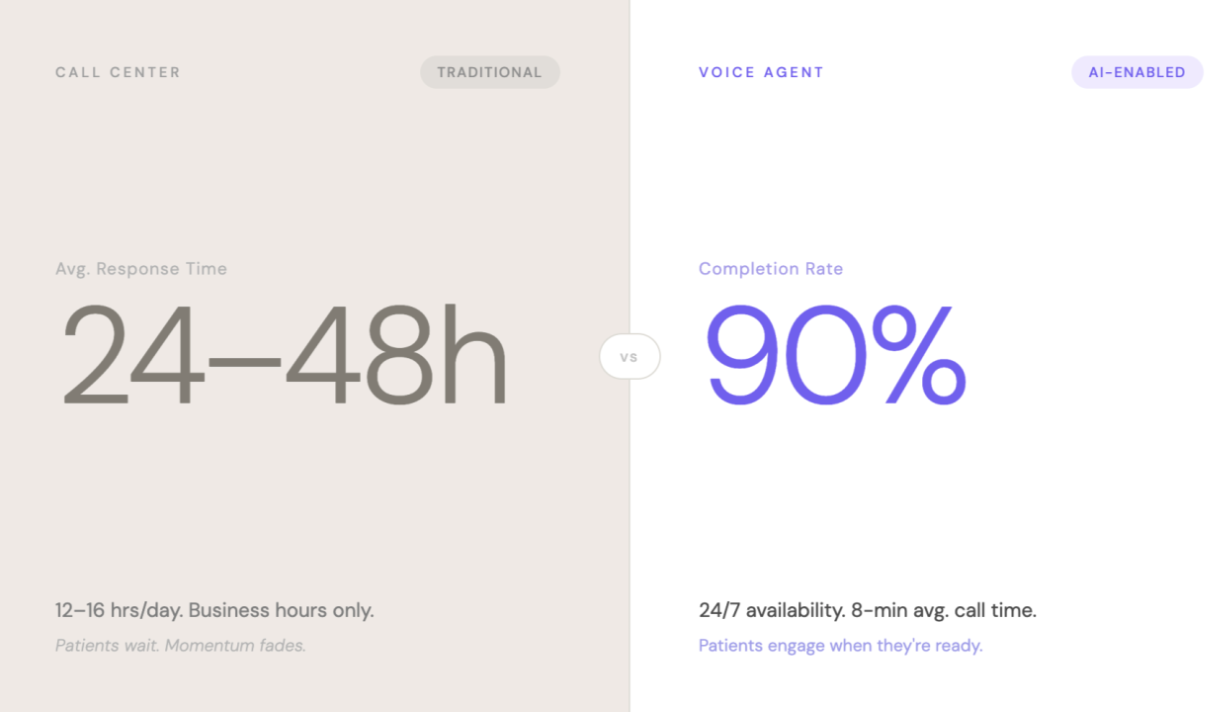
Traditional call centers usually operate only during standard business hours… typically 12-16 hours daily at most sites. Patient interest doesn't follow a schedule. When someone discovers your trial and wants to take action immediately, every hour of delay risks losing that momentum. Delayed responses often lead to missed enrollments, which triggers a costly chain reaction: extended enrollment periods, pressure to activate additional sites, and pushed-back timelines. Each missed patient today can mean weeks or months added to your trial.
The Traditional Call Center Model: Built for Volume, Not Velocity
Most recruitment vendors default to the same playbook: digital advertising drives leads to call centers, human agents follow scripts to assess eligibility, qualified patients get referred to sites.
This model works... at a pace that feels increasingly outdated.
The operational reality: Call centers typically operate 12-16 hours daily with response times averaging 24-48 hours. Contact center agent turnover averages 30-45% annually, requiring continuous retraining cycles that can impact consistency.
Scaling requires hiring and training more humans, creating operational lag times of 4-6 weeks. Additionally, there is the cost per call to account for (which we won't even try to monetize for the purpose of this article).
The AI "Patient Support Agent" Alternative: Rethinking Patient Pre-Screening
Modern voice agents conduct natural conversations, adapting their questioning based on patient responses while maintaining protocol accuracy.
Power's approach: Our voice agent completes medical history verification through conversational AI that patients can access 24/7, generating structured transcripts tied directly to protocol criteria.
The performance metrics tell a different story. Our completion rate hits 90% and the average call time is only 8 minutes. Patients access the system anytime, anywhere, with zero wait time.
Consider what this means for enrollment timelines. Every day of delay in initial screening adds another day to enrollment. When patients complete pre-screening immediately instead of waiting for callbacks, you compress timelines while capturing higher-quality data.
The Comparative Reality: Where Each Model Excels
Call Centers Excel At:
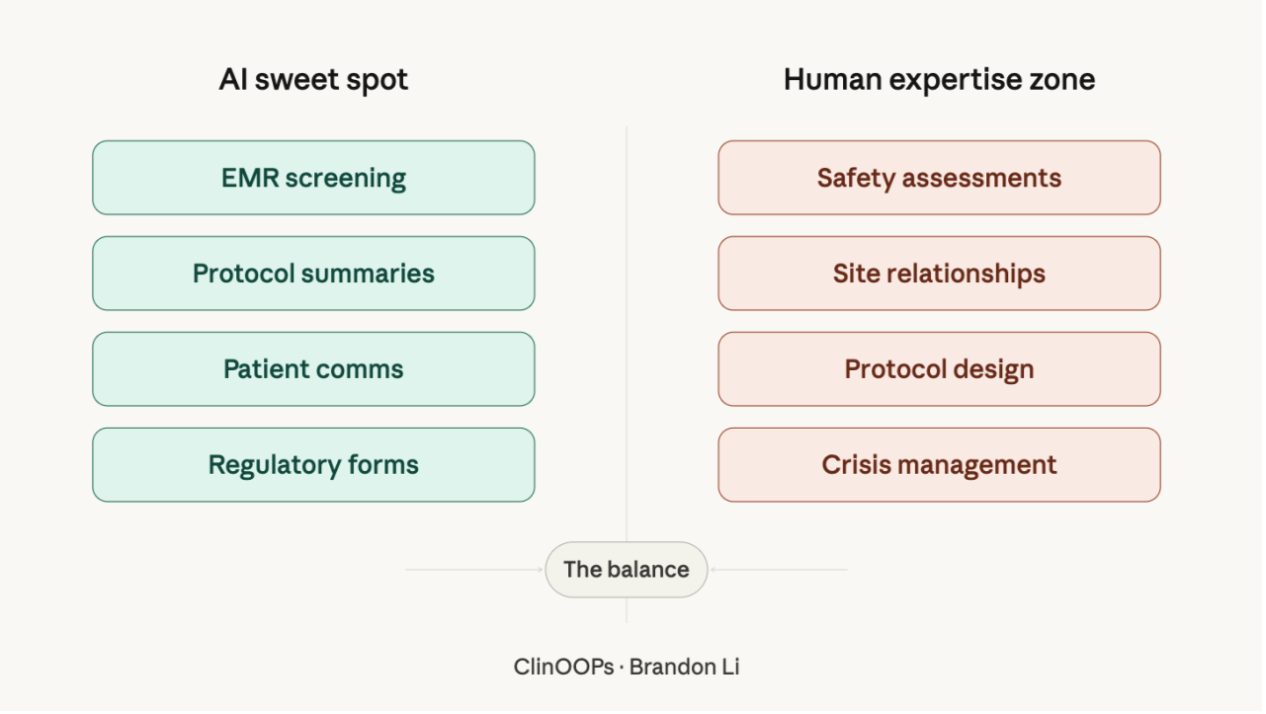
Handling complex FAQs and therapeutic-specific questions. When patients ask nuanced questions that go beyond eligibility — such as "How does this compare to my current treatment?" or "What happens if the study drug doesn't work for me?" — human agents with therapeutic area knowledge can typically provide informed responses that AI agents can't (currently) handle reliably.
Relationship building through the enrollment journey. Human call center agents can build rapport with patients over multiple touchpoints, acting as a familiar voice who addresses concerns and encourages follow-through. This human connection can help patients feel more confident about committing to trial participation.
Handling discrepancies between patient reports and medical records. When a patient's self-reported medical history doesn't align with their EMR (which ~71% of Power's patients willingly consent to share) or prescription data, human agents can ask clarifying questions to resolve inconsistencies and determine actual eligibility. "You mentioned you're not on any Alzheimer's medications, but your records show a donepezil prescription… can you tell me more about that?" (Power's portal reconciles these discrepancies automatically, but human agents can often navigate the in-call conversation more naturally.)
Detecting patient hesitation or concern through tone. Human agents can pick up on vocal cues — uncertainty, anxiety, confusion — that might indicate a patient needs more explanation or reassurance, even if their words say "yes, I understand."
Patient Support Agents Excel At:
Immediate response at scale. Capturing patient interest at the moment it peaks. No wait times, no business hours, no staffing constraints. Instead of call center queues, AI agents let patients complete pre-screening anytime, anywhere.
Reliable medical history confirmation. Some medical history is better shared verbally than through surveys. Sites spend significant time re-contacting patients to clarify details… voice agents handle this upfront, generating structured transcripts tied to protocol criteria. The consistent, protocol-accurate screening means voice agents deliver 100% script adherence, which can lead to better data quality and compliance compared to human agents who may deviate from scripts.
Structured data capture. Responses flow directly into searchable transcripts linked to specific eligibility criteria. Sites receive organized data rather than notes requiring interpretation — reducing the need for follow-up clarification calls. Every interaction is logged and analyzable: time to complete, drop-off points, patient sentiment, and other metrics that help optimize the screening process.
Higher confidence in patient fit before referral. By combining conversational data collection with EMR verification, voice agents provide sites with pre-qualified referrals, cutting back site workload significantly.
Cost efficiency at volume. Once developed, voice agents handle unlimited concurrent conversations at a fractional cost per interaction.
Integration with verification systems. Voice agents connect seamlessly to EMR screening, creating a unified pre-qualification process where transcripts flow into the Power portal alongside medical history data.
Real-World Performance: Power's Patient Voice Agent
Our deployment metrics:
Completion rate: 90% of patients who start the voice screening complete it. The difference appears to stem from immediacy — patients engage when motivated rather than playing phone tag.
Average call time: 8 minutes to collect complete medical history, confirm eligibility criteria, and answer any standard FAQs the patient may have.
Availability: 24/7 means patients in different time zones or with varying work schedules can complete pre-screening whenever it's convenient for them — no need to wait for business hours.
Data quality: Sites receive structured profiles with verified medical records, protocol-mapped eligibility assessment, and clear documentation / full transcripts. Not "patient reports previous medication use" but "Patient confirmed current use of donepezil 10mg daily, started March 2023, prescribed by Dr. Sarah Chen."
The "But What About..." Objections
"Patients won't trust talking to AI."
Patient acceptance of voice agents has been strong in our experience. The key appears to be transparency — we tell patients upfront they're interacting with an AI agent designed to collect medical information accurately. Some patients actually prefer the voice agent for discussing sensitive health conditions, as it can feel less intimidating and more judgment-free than speaking with a stranger.
"AI can't handle complex medical histories."
True for open-ended clinical assessment. Less true for structured eligibility screening. Voice agents excel at following decision trees and collecting protocol-specific data. The solution: Use voice agents for structured protocol criteria, escalate complexity to humans.
"What about regulatory acceptance?"
The FDA's December 2023 guidance on "Digital Health Technologies for Remote Data Acquisition" explicitly supports AI-driven data collection when properly validated. Power's voice agent collects and structures information, but humans make final eligibility determinations.
What This All Means For Your Next Trial
Consider these questions when planning recruitment strategy:
How quickly can your current system respond to patient interest? If patients must wait 24-48 hours for initial contact, you may be losing the engagement advantage that comes from immediate response.
How standardized are your eligibility criteria? Highly structured inclusion/exclusion criteria suit voice agents well. Nuanced clinical judgment requirements may favor human screening.
What's your target enrollment timeline? Trials with aggressive timelines can't afford delays inherent in business-hours-only call centers.
The Competitive Advantage Nobody Talks About
Here's what 1M+ patient interactions at Power have taught us: Patients often choose the trial that responds first.
When a patient discovers three potentially relevant trials, they tend to engage with whichever study responds fastest and makes participation feel achievable. Traditional call centers can create response delays. Voice agents capture that patient immediately.
The Bottom Line
Voice agents offer material advantages in availability, consistency, cost and data structure. They're not perfect for every scenario, but they excel at structured pre-screening while freeing human agents to focus on relationship building and complex cases.
The smartest approach: hybrid models that capture patient interest immediately through voice agents, then preserve human interaction for nuanced eligibility questions and final qualification steps.
Your patients get immediate engagement when motivation peaks. Your call center agents spend time on conversations that actually matter. Your sites receive better-qualified referrals with verified medical records already attached.
The question isn't whether voice technology will transform patient screening. It's whether your next trial will benefit from that transformation.
Brandon is Co-Founder at Power, where we've helped sites engage 1M+ patients through both traditional and AI-enabled approaches. Curious how voice agents might fit your next trial? Reach out at brandon@withpower.com.