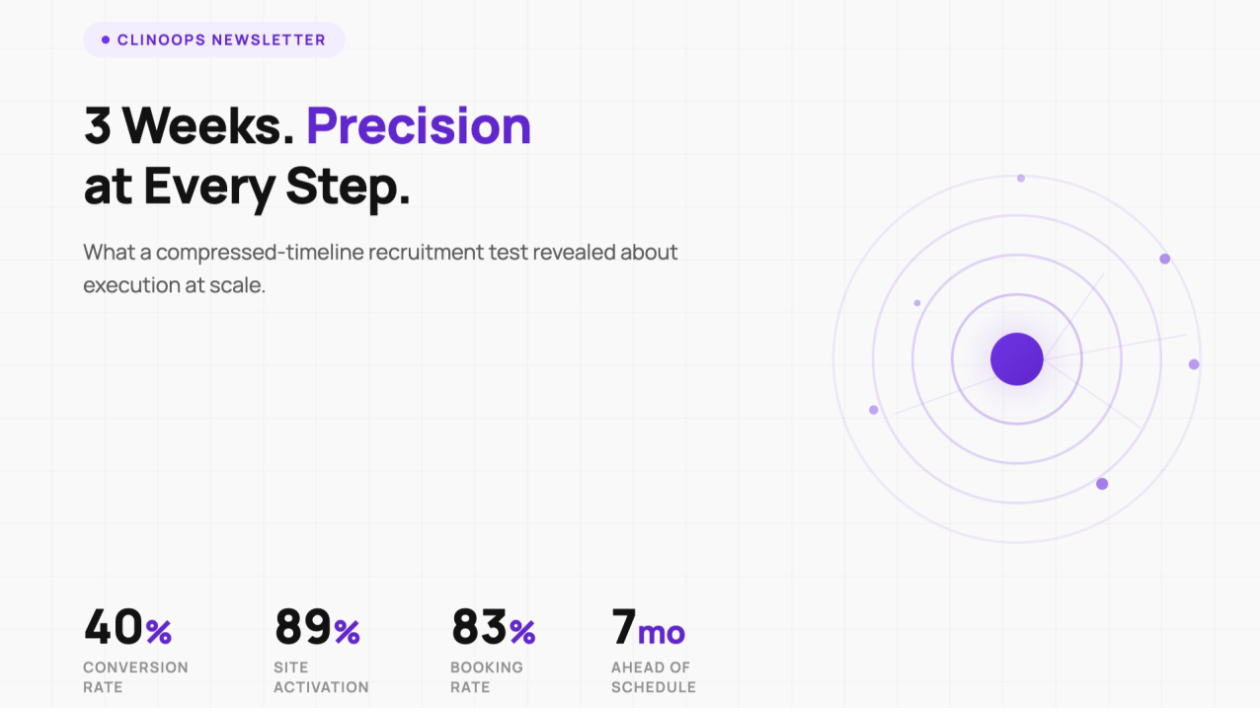
Three weeks. A sponsor gave us that window to evaluate whether recruitment could move at compressed-trial speed, with 83% of sites booking screening appointments by the end.
We're now eyeing Phase 3 together.
The Numbers
In three weeks, the recruitment funnel moved with precision. Power delivered 89 actual conversations with pre-qualified individuals, resulting in 31 screening appointments booked. That's a 40% conversion rate, which sits in the top quartile for patient recruitment in complex chronic conditions.
Meanwhile, 89% of sites activated and onboarded within the timeline. Of those sites with full two-week access, 83% booked at least one screening appointment.
What makes these numbers worth examining: the booking rate started at 50% and only tapered as sites filled their available screening slots. The limiting factor in this program wasn't patient demand. It was site capacity. For most trials, that equation runs in the opposite direction.
We expected the usual ramp. Instead, 40% of every conversation converted to a screening appointment in three weeks. That's not typical.
The result: the study is now seven months ahead of its original schedule.
These aren't vanity metrics. A 40% conversation rate, 89% site activation in weeks (not months), and 83% booking conversion all point to the same thing: a system that worked at scale and speed simultaneously. Sites were ready. Patients were motivated. The infrastructure processed them efficiently.
Why This Execution Worked
This kind of performance doesn't happen by accident. It's the result of a specific approach to recruitment infrastructure.
An engaged, research-curious patient community. Instead of broad awareness campaigns, this program drew from patients who had already expressed interest in clinical research... people already diagnosed, already in healthcare conversations about their condition, and already open to participating. When you're reaching patients who are research-curious by default, you're not selling the concept of a trial. You're matching them to the right one. That's what creates a pre-qualified funnel before any site conversation happens.
Sites enabled to move fast. An 89% onboarding rate in this window required more than willing investigators... it required operational support. Power's enablement platform helped sites activate protocols quickly, manage incoming referrals in real time, and maintain quality without the typical weeks-long ramp. Site readiness is often the invisible bottleneck in recruitment programs. When that bottleneck is addressed with infrastructure rather than just follow-up emails, activation timelines compress.
Pre-qualification discipline. The 40% conversion rate matters because 40% of all touched patients moved to actual conversations with clinical staff. That rate is only possible if the pre-screening process filters effectively for protocol fit before patients talk to coordinators. This protects site time and keeps genuine candidates in the funnel.
When these three elements work together, recruitment stops being a vendor activity. It becomes an operational partnership where timelines are preserved because the system processes qualified patients efficiently.
What the Sponsor Saw
During the program review with the sponsor's clinical operations leadership, the assessment was direct.
"This is FAR beyond what we expected."
That wasn't polite feedback. It was recognition that something structural worked. A three-week compressed-timeline test, usually a vendor credibility check, had delivered actual signal.
For a sponsor, that kind of feedback loop is rare. It means recruitment risk just moved significantly lower in the project hierarchy.
The Real Insight for Your Program
The bottleneck in most trials isn't actually recruitment. It's whether your recruitment approach can execute at the same velocity as your trial operations. When those velocities misalign, you get delays. When they align, you get this result.
The question worth asking your recruitment partners: Can you show evidence that your system consistently pulls patients through from ID to ICF within the window when motivation is highest and the trial is ready? Not eventually. Not after follow-ups. But when it counts.
Most can't. That's usually where recruitment friction lives.
This program suggests what happens when that friction dissolves. It's not flashy... it's operational excellence at scale.
Reach out if you have any questions: brandon@withpower.com