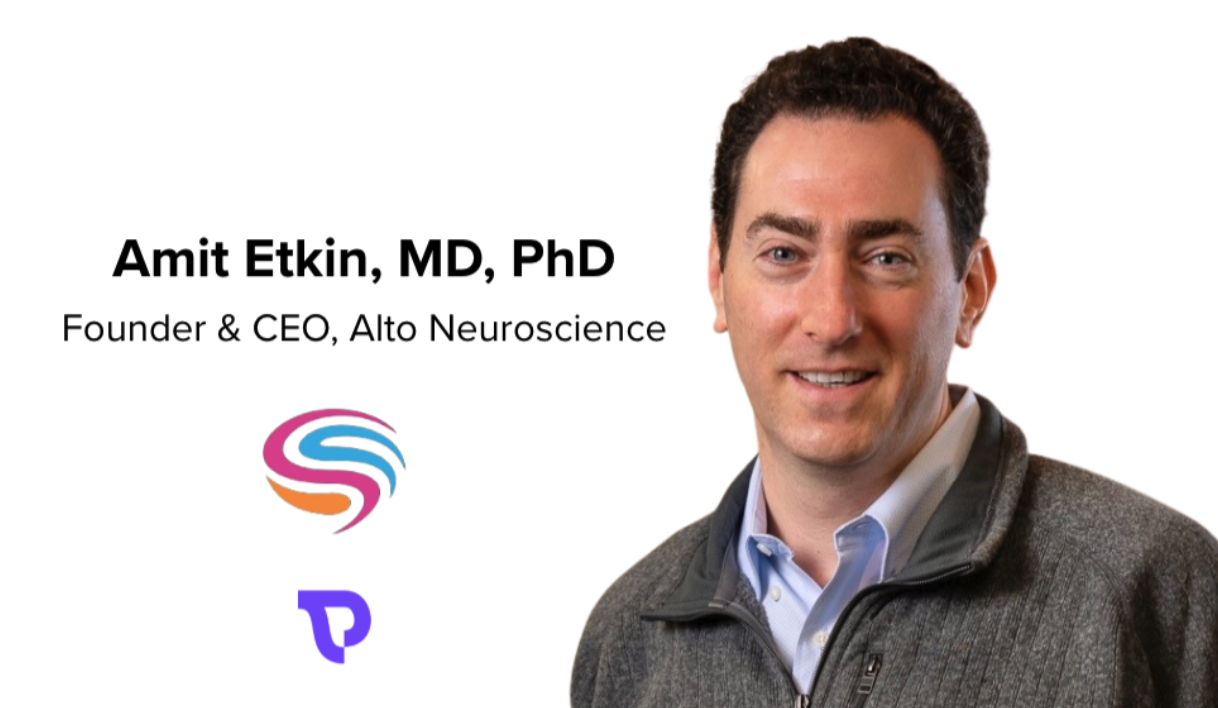
"The last paragraph in a paper is often what you really want to be doing... I came to appreciate that the nature of how science is structured in academia, the nature of the funding, the nature of the kind of work you could do, limits you to just speculating about that last paragraph."
— Amit Etkin, MD, PhD · Founder & CEO, Alto Neuroscience
"The last paragraph in a paper is often what you really want to be doing," Amit Etkin told me when I sat down with him last year, describing the frustration that eventually drove him out of academia entirely. "The implications of this work are A, B, C, D, and that's the future direction, that's what you're really excited about."
He paused.
"I came to appreciate that the nature of how science is structured in academia, the nature of the funding, the nature of the kind of work you could do, limits you to just speculating about that last paragraph."
By the time Etkin had that realization, he had every reason to stay where he was. Full professorship at Stanford. NIH Director's Pioneer Award. A productive lab publishing consistently in top journals. The academic trajectory was secure. But there was a problem he couldn't solve by writing more papers.
What Academia Won't Let You Do
Etkin had spent years studying brain circuits, mapping how different neural systems corresponded to psychiatric symptoms, developing computational approaches to analyze brain data. The research was solid. The papers got published. But the gap between published findings and meaningful change in clinical practice remained frustratingly wide.
He knew what the solution should look like: measure brain biology at the individual level, match patients to treatments based on objective data, develop new therapeutics designed around measurable brain circuits rather than discovered through serendipity. He had the scientific foundation. He had the computational tools.
What he didn't have was a way to actually execute from within Stanford's walls. The academic funding model couldn't support what he needed to build — the operational infrastructure to collect high-quality brain measurements at scale, the machine learning pipelines to discover biomarkers, the clinical development apparatus to test whether any of it worked. "You can't develop new therapeutics, new interventions, new diagnostics just through serendipity," Etkin said.
So in 2019, he walked away.
The Infrastructure Nobody Sees
What Etkin discovered after founding Alto Neuroscience was how much of the work involved operational infrastructure.
"We spent a while just figuring out literally the logistics, the procedural aspects, the writing of software that does realtime quality control and gives feedback to the sites," he explained. The goal was to collect research-grade EEG data at trial sites where staff had "never touched EEG until you walked in their door."
Think about what that requires: software that guides data collection in real-time, remote troubleshooting capabilities, quality control algorithms that work blindly on the backend, operational protocols that work at 100+ sites across the United States. "We've already in our studies acquired data in patients' homes," Etkin noted. "We've already started working with systems that are lower electrode counts that a person can put on themselves guided by software."
This is the work that doesn't typically get published in Nature. It's the operational execution that makes the difference between an interesting academic finding and something that could actually help patients at scale.
This operational foundation was meant to enable what academic labs couldn't do: test biomarker-guided treatment at scale across distributed sites.
The Execution Reality
The academic fantasy is that good science leads directly to better treatments. The reality, as Etkin has learned over the past five years, involves the typical challenges of drug development at scale.
Alto's lead program in MDD completed its Phase 2b trial in October 2024, and while the primary endpoint wasn't met, the company continued development of other programs. The company raised additional capital and is advancing multiple programs toward 2026 readouts.
"You can't manipulate that which you cannot measure," Etkin said, describing his core philosophy. "We basically started with a brain circuit perspective of taking apart which are the key circuits that we think are most important to attack across a range of different diseases, and then mapping onto them biomarkers to measure them, and onto that potential drugs."
"We're literally discovering things out of our data, out of other data, out of our kind of understanding and changing our approach and mindset every single day," he explained. "You feel like you're at the frontier, and yes that's hard, but it's also really exciting."
Looking Ahead
Data readouts in 2026 will test what precision psychiatry looks like when it scales beyond academic papers — whether the infrastructure he built can turn biomarker science into drugs that actually show efficacy in controlled trials.
But the more fundamental question is whether psychiatry can move beyond trial-and-error treatment at all. "I'd love to see in the near term the first precision therapeutic approved," Etkin told us. "I want us to be the first to cross that line."
No psychiatric drug has been approved with a biomarker-required indication. Academic labs continue publishing interesting findings about brain-based subtypes and treatment predictors, but few are building the operational infrastructure to actually test whether it works at scale, across sites, in the hands of clinicians who aren't computational neuroscientists.
That's what Etkin is doing in the real world, beyond the "last paragraph" of academic papers.
Watch the full video podcast here.
Brandon Li · Co-Founder, Power
For clinical operations teams navigating patient selection strategies in CNS & I&I trials: Talk to our team about what we're learning from sponsors pushing the boundaries.